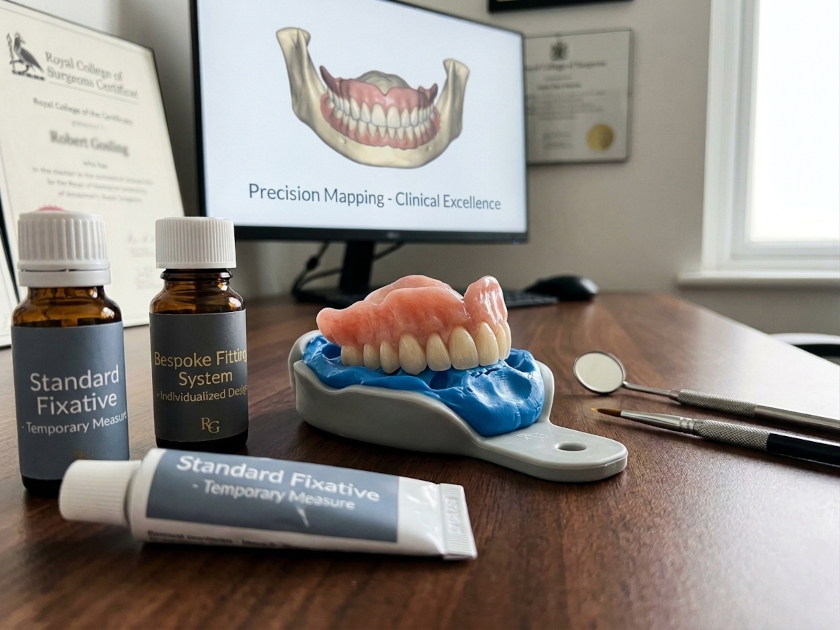
For millions of people, dentures are essential for daily life—enabling you to eat, speak, and smile with confidence. Yet all too often, patients find themselves slowly adapting to a smile that no longer fits: using more adhesive each morning, avoiding firm foods at dinner, or wincing from sore spots that never seem to clear up.
If you are living with denture discomfort, it is easy to assume this is simply an inevitable part of getting older or wearing full appliances.
The truth is simple: dentures should never feel like a constant compromise.
Understanding why your dentures are slipping, how unaddressed fit issues affect your health, and what can be done about it is the first step toward getting your quality of life back.
1. Why Do Dentures Stop Fitting Properly?
It is rarely a case of poor care; rather, it is a combination of natural anatomy and how standard dentures are made.
Natural Jawbone Resorption: After teeth are removed, the underlying jawbone slowly and naturally changes shape over time. As the bone recedes, a denture that fitted perfectly five years ago can gradually lose its precise seat against your gums.
Mass-Produced Standards: Many commercial dentures are fabricated using standardized molds sent off to external mass-production labs. Without custom anatomical shaping, they lack the delicate perimeter seal needed for naturally secure retention.
Wear and Tear of Materials: Over years of chewing, acrylic teeth and bases experience microscopic wear, altering your bite alignment and causing subtle movement during speech or eating.
2. The Unseen Impact on Your Health & Features
Poorly fitting dentures do far more than just slide around. Leaving fit issues unaddressed can lead to a domino effect of physical and cosmetic challenges:
Persistent Tissue Damage and Ulcers
When a denture shifts, it creates localized friction points against delicate gum tissue. Over time, this constant rubbing leads to painful inflammation, persistent mouth ulcers, and fibrous tissue growths that make wearing any appliance unbearable.
Loss of Facial Support & "Sunken" Features
Your teeth and jawbone provide the essential structural framework for your lower face, lips, and cheeks. When dentures lack proper vertical height or precise facial contouring, the lower face can begin to look collapsed or sunken—adding years to your facial profile.
Digestive and Nutritional Strain
When chewing becomes uncomfortable or unstable, diets naturally change. Many sufferers gradually eliminate fresh fruits, raw vegetables, and lean meats, relying instead on soft, processed foods. This subtle shift can compromise your digestive health and overall nutrition.
Accelerated Bone Loss
An unstable denture creates uneven, heavy pressure points across your ridge during chewing. This improper force distribution actually accelerates bone loss rather than preserving what remains.
3. Beyond Fixatives: The Case for Bespoke Craftsmanship
Denture adhesives and extra tubes of fixative are temporary band-aids. They cannot correct an inaccurate bite, restore lost facial height, or recreate a lost perimeter seal.
True comfort comes from blending rigorous clinical standards with individualized laboratory artistry:
Direct Clinical Care: When you work directly with a qualified Clinical Dental Technician, the person measuring your mouth is the exact same person handcrafting your teeth. There is no middleman and no loss of detail in translation.
Anatomical Realism: Using advanced impression techniques, every contour of your gums, lip support line, and natural bite is captured down to the millimeter.
Hand-Finished Artistry: High-end materials allow for subtle tooth shading, natural translucency, and individualized gum contouring—ensuring your new smile looks authentic, vibrant, and entirely your own.
Ready to Rediscover Comfort and Confidence?
Living with loose or painful dentures does not have to be your baseline. Whether your current set needs an expert evaluation, a precision reline, or a complete bespoke redesign, specialist care is available.
Take the First Step
You don't have to navigate denture issues alone.
Request a Private Consultation with Rob today to discuss your options in a relaxed, confidential environment.
Robert Gosling, CDT RCS (Eng)
Clinical Dental Technician & Founder, The Palette System
rob@robertgoslingdentures.co.uk
Written by Robert Gosling | Published on November 5, 2026
Share this article
Help others discover the Palette System by sharing this article on social media.